Danish–French training in helicopter transport
As part of exercise activities, a Danish Seahawk helicopter was transported last week by a French military aircraft from Karup Air Base to Keflavík, Iceland. The purpose was to train a more efficient relocation of Denmark’s maritime helicopter capability in cooperation with NATO allies.
March 10, 2026 - 11:28
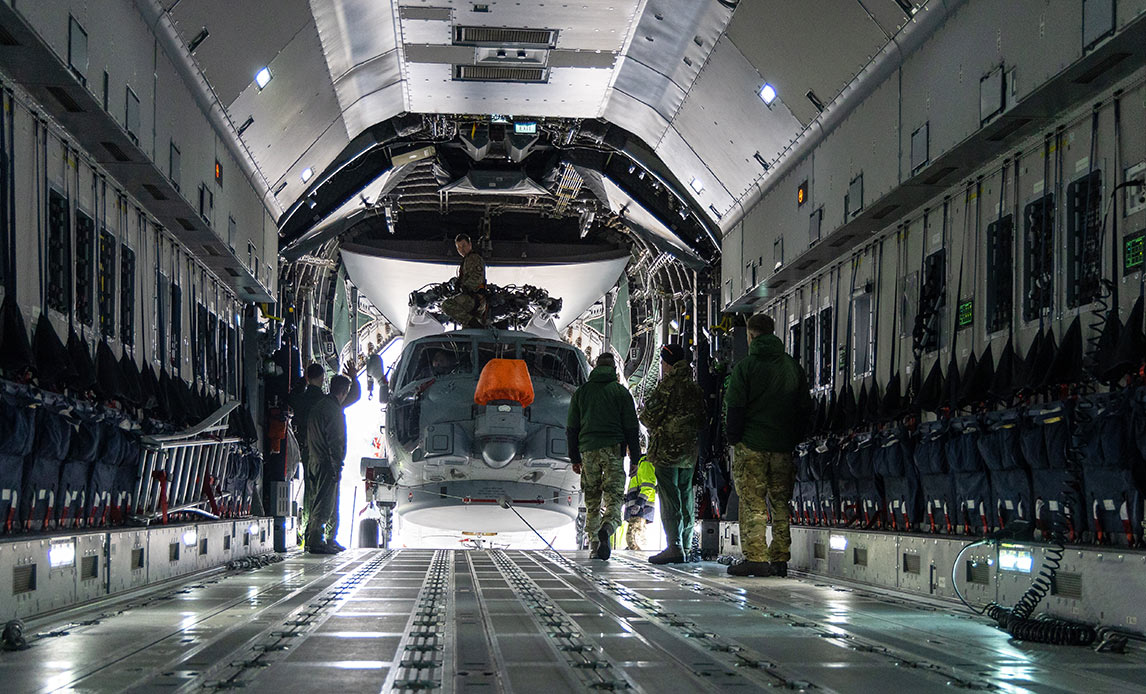
The Seahawk-helicopter beeing loadet on to the Frech cargo plane. Photo: Sofie Bock Troelsen / Operational Support Command
By Danish Defence Maintenance Service / Operational Support Command / Helicopter Wing
A new chapter in the Danish Armed Forces’ use of the Seahawk helicopter was written in the beginning om March, when a French transport aircraft departed Karup Air Base carrying a Danish Seahawk helicopter in its cargo hold.
The flight formed part of an exercise testing the possibility of faster, more efficient and safer helicopter transport with support from Denmark’s allies.
The helicopter had been in Denmark for scheduled maintenance and was therefore returning via Iceland to operational service aboard a Royal Danish Navy vessel deployed in the North Atlantic. It will replace another helicopter that returned to Denmark on the same flight.
Saving valuable flight hours
Helicopters are rotated at regular intervals as part of scheduled maintenance cycles. What made this case different was that the helicopter was transported rather than flown to its destination.
“The advantage is that we don’t have to fly the aircraft there ourselves. We can save a significant number of flight hours — hours that can instead be used for operational tasks in the area of operations rather than for transit,” said CAD, a Seahawk pilot, during the flight to Iceland.
In addition to making better use of flight hours, air transport can also be both more flexible and safer.
Normally, crews from Squadron 723 fly the helicopters themselves to and from ships in the North Atlantic with several stops along the way. This can involve risks, as the region is known for rapidly changing and sometimes severe weather conditions.
“Compared with flying ourselves to Iceland and operating over large open sea areas with limited landing options, air transport is a safer way to do it,” CAD explained.
Limited space in the cargo hold
Even though the cargo hold of an Airbus A400M is very large — approximately 340 cubic metres — space was still limited. Not in width or length, but in height.
A Seahawk helicopter measures 5.10 metres in height in its operational configuration and has a rotor span of 16 metres.
Inside the transport aircraft, the cargo hold height is 3.85 metres.
Fortunately, the helicopter is designed to be folded to fit into the hangar aboard the Royal Danish Navy’s inspection vessels. The rotor blades can be folded and the tail section can be hinged.
Even in this folded configuration, however, the Seahawk’s listed height is 3.94 metres.
So what did the technicians do?
One solution was to partially deflate the helicopter’s tyres. This allowed the aircraft to be carefully winched into the cargo hold of the French transport aircraft — slowly and without damage.
Strong cooperation with allies
The transport was made possible through close cooperation between personnel from the Danish Defence Maintenance Service, Helicopter Wing, and the French aircrew.
“Cooperation with the French has been excellent — it has been a real pleasure,” said Captain Christoffer, who continued:
“An exercise like this involves many parts of the Danish Armed Forces and the Air Force. Several authorities must contribute to create the conditions that make such an operation possible. Our technicians, with their experience, skills, practical solutions and professional mindset, ensured that the helicopter rotation was a success.”
The exercise has now confirmed that Danish Seahawk helicopters can be transported aboard allied Airbus A400M aircraft if required in the future.
“We have now produced a loading sheet — something we did not have before. A procedure for this type of transport has been established, so we now know exactly how to conduct it in the future,” Christoffer explained.
“It is extremely valuable that the Danish Defence Maintenance Service and Helicopter Wing can train this capability. It confirms that we can rely on it in the future. We greatly appreciate the opportunity to train and conduct this type of transport together with our close allies,” CAD added.