The Royal Danish Navy holds the DANEX exercise in Danish home waters
Next week, the Royal Danish Navy will hold its annual DANEX exercise. The large-scale exercise will involve several warships, helicopters, drones and other units, as well as around 650 sailors. The exercise focuses on the protection of the Kingdom of Denmark and, by extension, NATO.
August 11, 2026 - 17:00
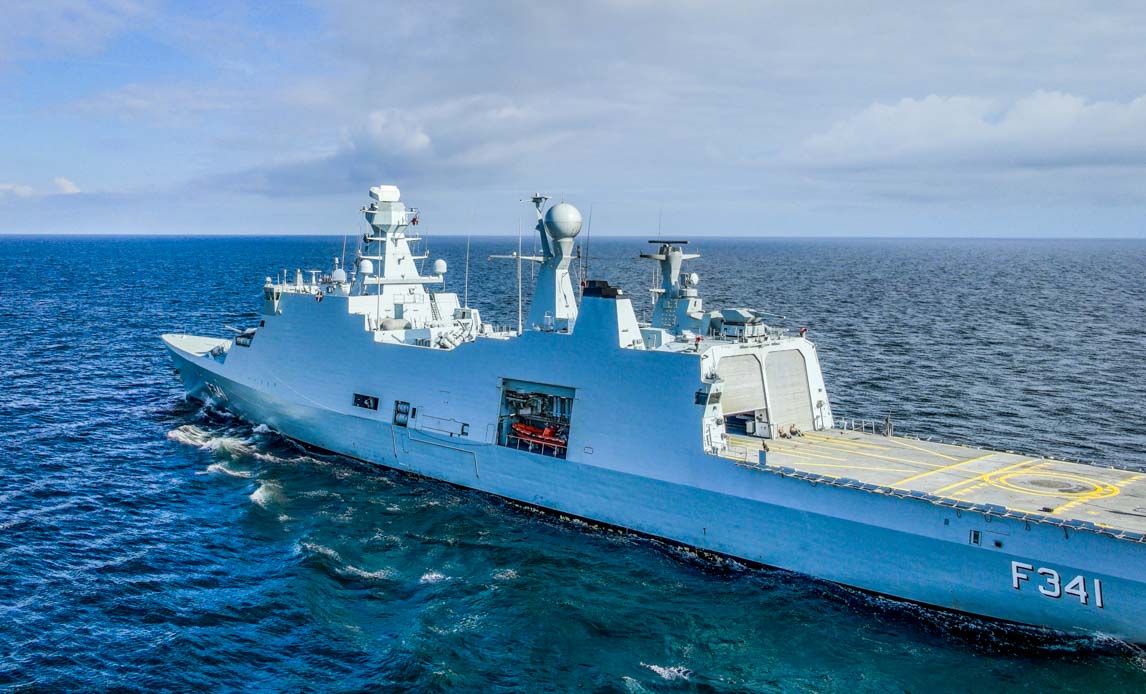
Photo: Danish Defence
By Danish Defence
Next week, the Royal Danish Navy will have a greater presence than usual in Danish home waters, as the annual DANEX exercise takes place. This is a major Danish naval exercise running from 11–19 August, involving approximately 650 officers, sergeants and constables from the Royal Danish Navy and the Danish Naval Home Guard.
DANEX gives the Royal Danish Navy's units the opportunity to practise maritime operations, which are central to the overall defence of the Kingdom and NATO. This year, this includes practising the protection of selected parts of the maritime infrastructure – including access routes to the Baltic Sea.
With the frigates Absalon, Esbern Snare and Peter Willemoes, the diving vessel Søløven, around ten smaller units, two helicopters and several drones, the Royal Danish Navy will train carrying out its core maritime task.
In addition to the Royal Danish Navy's units, the Royal Danish Air Force is contributing maritime helicopters to the exercise, while the Danish Naval Home Guard acts partly as a participant and partly as an opposing force under realistic, present-day conditions.
"The DANEX exercise is important for ensuring that the Royal Danish Navy can carry out its core task and maintain a high level of operational readiness," says Rear Admiral Søren Kjeldsen, Chief of the Royal Danish Navy. "By training with our own forces, we can focus on specific scenarios and challenges that are relevant to the protection of our waters and Danish sovereignty, and to NATO's overall mission accomplishment."
The exercise is coordinated by the Danish Task Group, led by Commodore Bo Overgaard. Danish Task Group is responsible for ensuring that the exercise proceeds as planned and that its objectives are achieved.
"The Danish Task Group's task is to control and facilitate an exercise in which all elements of the fleet, including staffs ashore, can gain relevant training value," explains Commodore Bo Overgaard. "DANEX gives us the opportunity to test our procedures and ensure that communication and cooperation between units are optimal."
The exercise provides valuable training in complex maritime operations and coordination between different naval branches. Through DANEX, the Royal Danish Navy maintains its operational readiness, develops tactics for the protection of Danish territorial waters and maritime infrastructure, and at the same time demonstrates its important role in Danish defence and security.
By training in Danish home waters, the Royal Danish Navy builds its ability to continue protecting national interests and maintaining maritime control in Danish waters at a time when new technology, such as drones, is affecting the maritime domain.