NATO forces have completed unique training in Greenland
For just under two weeks, soldiers from 11 NATO countries have been training together in Greenland’s harsh terrain. Over 400 soldiers have trained side by side in exercise Arctic Shield and can now return home with invaluable knowledge of how to fight and survive in the Arctic.
September 18, 2026 - 10:28
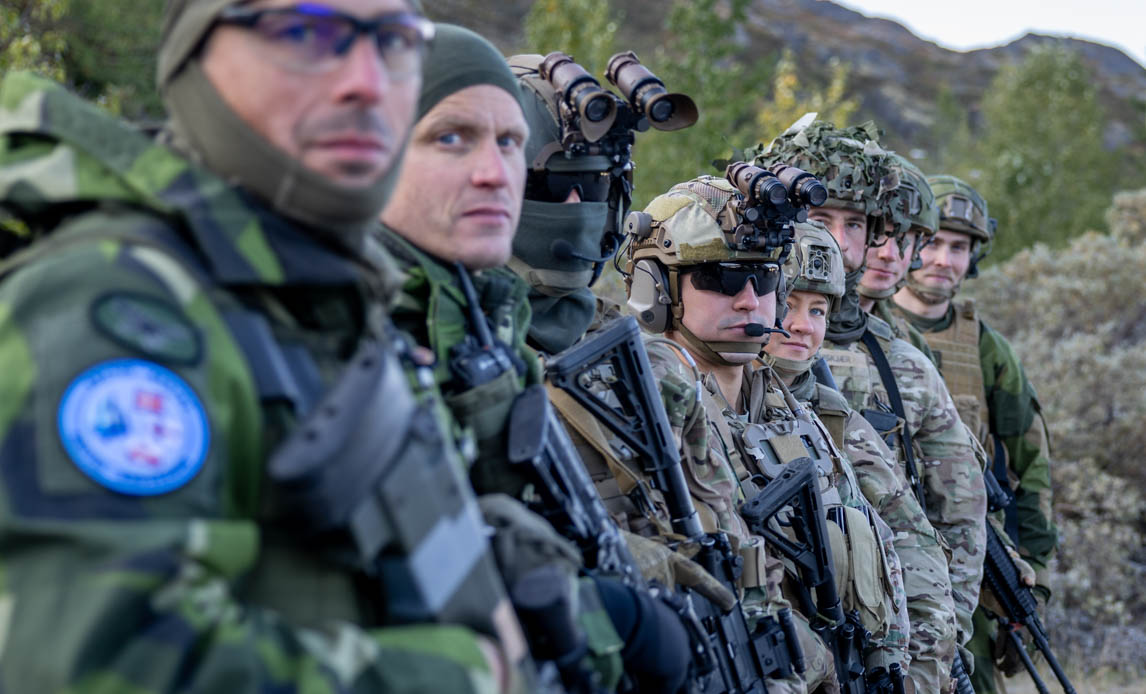
Photo: Danish Defense
By the Danish Defense
The first thing that strikes you when you land in Narsarsuaq in South Greenland is the view. Huge mountains, icebergs in the fjord and, far off in the distance, the ice sheet, which stretches almost endlessly towards the horizon. The second thing that strikes participants in the Arctic Shield exercise is just how busy the two Danish EH-101 helicopters are.
They are crucial to the exercise’s success and to getting the soldiers to their destinations. There are no roads up into the mountains and everything is a long way away. That is why soldiers from France, Belgium, Finland, Sweden, Norway and Denmark are flown out to carry out their missions in the terrain.
And that is precisely one of the main objectives of this major exercise in Greenland: for the soldiers to experience first-hand just how difficult it is to fight and survive in the Arctic, where the natural environment is harsh and unforgiving.
“Arctic Shield is an exercise bringing together 11 different nations. The aim of the exercise is to develop our ability to operate in the Arctic – both as a nation and alongside our NATO allies,” says Major Christian Mogensen, commander of the Arctic Shield exercise in Narsarsuaq. “It is important that we have a mutual understanding of how we operate together across NATO up here. The Arctic is a new arena for many nations, which places a number of new demands on us as soldiers. The terrain, weather and distances are vastly different from what we are used to back home.”
400 soldiers from 11 NATO countries
During the exercise, over 400 soldiers from 11 NATO countries have gathered in the village of Narsarsuaq in South Greenland. Here, Arctic Command has rapidly set up a headquarters, from which all tasks and missions during the exercise are coordinated.
“The Arctic and the North Atlantic are becoming increasingly important strategically. That is why it is really important that we train together in Greenland. The geography, climate and weather are so different here compared to Europe that it makes a great deal of sense for us to train alongside our NATO allies,” says the head of the Joint Arctic Command, Søren Andersen. “The exercise helps to emphasise that, together with allied forces, we are defending NATO’s northern flank.”
Most of the exercise’s activities took place around Narsarsuaq in South Greenland, but there were also soldiers on exercise around Kangerlussuaq further north. Among others, Dutch soldiers have been training there.
International exercise with NATO allies
The exercise is called Arctic Shield and forms part of NATO’s activities in the Arctic, known as Arctic Sentry.
As part of Arctic Shield, soldiers from other NATO countries – including Finland, which has sent a platoon of special operations soldiers – have been out on the ice sheet for several days, where they have, amongst other things, carried out reconnaissance in the area and trained in survival skills, glacier climbing and marching in the harsh Greenlandic wilderness.
The Finnish commander of the troops described the area as beautiful, like something out of a Disney movie, where his soldiers were living out their dreams.
“The most important thing we’ve learnt is that Greenland presents a major logistical challenge. This is hugely important training that we’ll take home with us,” says Captain Stone from the Utti Jaeger Regiment. “We come from a country with an incredible amount of forest and very flat terrain. This is the complete opposite. But fundamentally, we have learnt that our procedures and equipment also work here in the Arctic.
Both French and Belgian soldiers are taking part in the exercise with drone units. And for them, the exercise in Greenland alongside NATO partners is important.
“Working with the Danes, the helicopters and the medical personnel has been a real learning experience. The same goes for the Belgians, who provided support with drone surveillance on the ice sheet. It’s been really good. We’ve also learnt that we need to be flexible and adaptable up here. Ultimately, it’s Mother Nature who decides what we can and cannot do. Mother Nature has been the exercise leader," says Captain Stone from the Finnish Special Operations Forces.
Arctic specialists from Canada are taking part, sharing their experience and knowledge of the harsh Arctic conditions with allies from other NATO countries – just as Canada is also supporting the exercise with transport capacity.
Home Guard soldiers in the Arctic
A large part of the Danish contribution to the exercise has consisted of Home Guard soldiers from several districts. Throughout the exercise, they have trained alongside their colleagues from the Swedish and Norwegian Home Guards. But they have also received training in navigating the Arctic terrain, and they have engaged in combat against, amongst others, French soldiers during the climax of the exercise.
“I am impressed by the soldiers – all the soldiers up here. They are skilled, they are hugely motivated and have a positive approach to tackling the tasks. And this applies across all nations. It is encouraging to see the willingness to help one another across national boundaries,” says Gunner Arpe Nielsen, Chief of the Home Guard.
“Our most important task is to support the Armed Forces in carrying out their missions. This also means that we must be able to provide support for missions in the far north. That is why we train soldiers to carry out precisely this kind of mission. When we do so, it is important that we have the opportunity to come up here and operate within a framework involving several nations, in the right climate and on the right missions,” says Gunner Arpe Nielsen.
The Defence Command and the Joint Arctic Command support the training activities on land with helicopters, ships, medical expertise and facilities, and logistical support for the participating nations; however, the individual nations have been responsible for determining the content of the various exercises in the mountains and on the ice themselves.
Alongside Arctic Shield 2026, other training and presence operations are being carried out in the Arctic as part of NATO’s enhanced presence. This includes, amongst other things, air operations in the Arctic, where Danish, Canadian and American fighter aircraft are training together, supported by several specialised aircraft types over Greenland.
The exercise has been organised in close coordination with the Greenlandic Self-Government and the local municipality in South Greenland. The Greenlandic Minister for Foreign Affairs therefore also visited the exercise, accompanied by the Minister of Defence, the Chief of Defence and the mayor.