Testing of Underwater Drone near Greenland
The Royal Danish Navy has, together with colleagues from Canada, tested underwater drones in Greenland's cold and deep waters. The drones are intended to strengthen the Defence's capability to secure the seabed and monitor critical infrastructure.
June 23, 2026 - 10:00
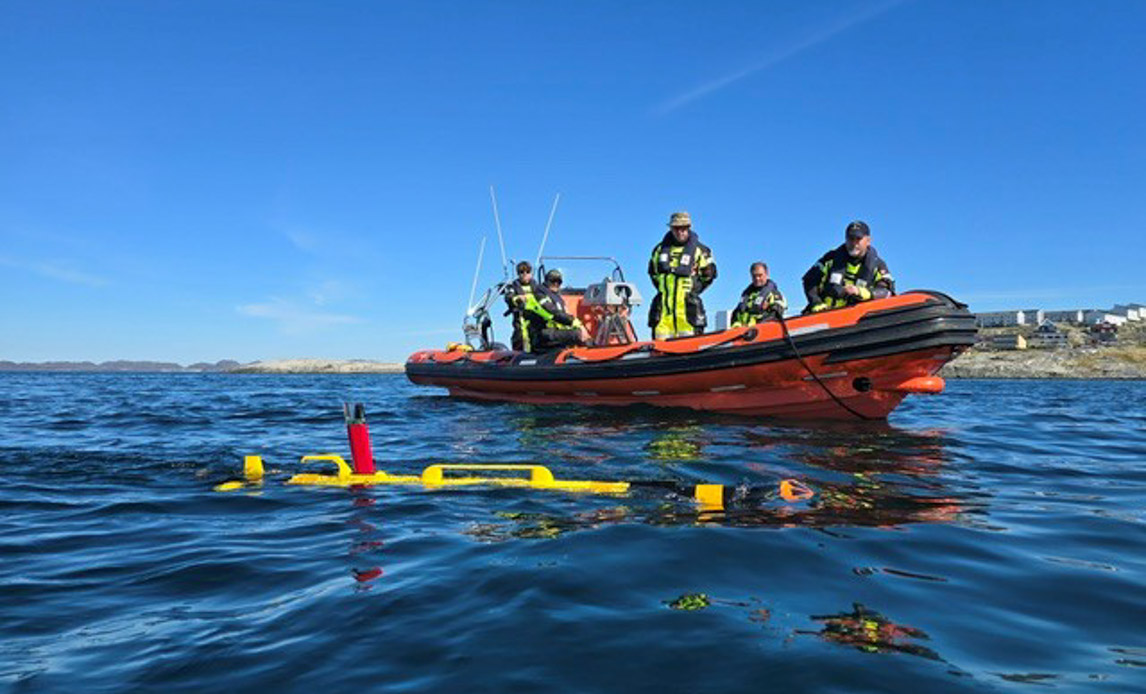
Photo: B. Märcher / Danish Defence
By the Danish Defence
In the ice-cold blue sea off Nuuk, sailors from the Royal Danish Navy have recently had their eyes fixed firmly on the seabed. There, they have tested and trialled their underwater drones together with Canadian colleagues.
Normally, the underwater drones operate in home Danish waters, where the seabed and water temperature differ markedly from those in Greenland. For this reason, Jan Stripp, head of the Royal Danish Navy's Subsurface & Seabed Warfare division, has travelled to Greenland with his team.
"We want to challenge ourselves and the drones in Greenland, where both the drones and we are outside our comfort zone. Now we are testing what we can do with the drones in the cold, deep waters of Greenland," says Jan Stripp, head of the Royal Danish Navy's Subsurface & Seabed Warfare division.
The Royal Danish Navy's Subsurface & Seabed Warfare division is testing the underwater drones as part of the increased support to Greenland in connection with Arctic Endurance, in collaboration with Arctic Command.
"We need to get better at using the drones, but also at finding their limitations in other waters. We have different types of drones, and we need to find out which works best in the cold and clear seas around Greenland. It is an entirely different task in Greenland's waters than at home," says Jan Stripp.
Video: Danish Defence
Important Collaboration with Canada
The testing and exercise in Greenland is taking place in collaboration with Canada. Joint training between the divers and drone operators has been ongoing for many years in order to strengthen cooperation.
"We get a great deal out of this collaboration, because our setup is mobile. We must be able to deploy and work on different platforms such as, for example, ships, so we train to go out and work under realistic conditions," says Jan Stripp. "The Canadians also have some different drones and working methods. So we can learn a great deal from one another."
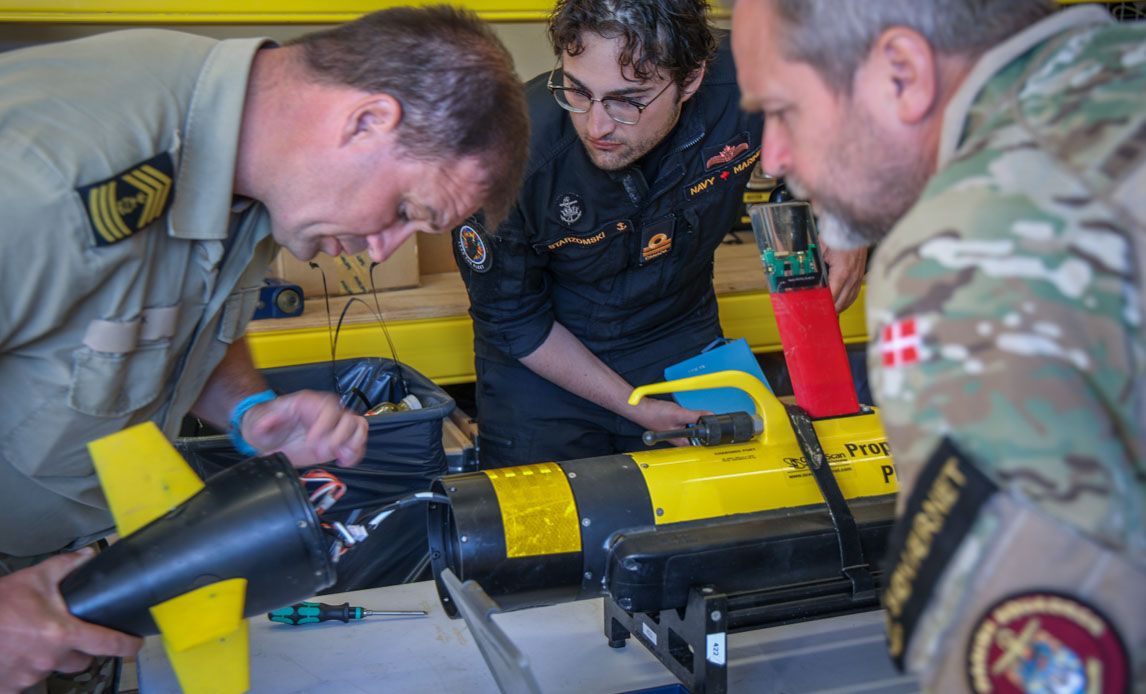
Photo: Maja Hald / Danish Defence
Last year, the joint training took place alongside NATO's standing mine countermeasures group SNMCMG1, where Canada contributed two ships and Denmark contributed a sensor team (divers and drones).
"The collaboration is enormously important, as they can provide ships and platforms – and thereby increase our ability to deploy. We work from a toolbox system, in which we possess different tools that can be deployed on different platforms (ships)," says Jan Stripp. "We are working towards becoming increasingly mobile, so that we can deploy and be used anywhere."
During the current trials in Greenland, Canada is contributing two observers who are following the Danes and learning from Danish know-how.
“The opportunity to observe these trials provides the Royal Canadian Navy insight into the capability of allied technology operating in Arctic waters. By combining our expertise with that of the Royal Danish Navy, we are strengthening our collective ability to monitor the seabed and protect critical infrastructure across northern regions,” said Lieutenant-Commander Greg Richards, Canadian Fleet Atlantic Mine Warfare Officer. “Just as importantly, working alongside our Danish partners enhances our interoperability and deepens our shared understanding of the unique challenges associated with operating in an Arctic environment.”
Critical Infrastructure
An important part of the exercise and training in the Arctic also concerns the Royal Danish Navy's aim to build a picture of what is taking place beneath the sea surface across the entire Kingdom.
The protection of critical infrastructure is essential to the security and cohesion of the Realm, which is why many different authorities are involved in the monitoring and protection of the infrastructure.